



- Blood Loyalty and Paradise: A Jack Hammer Memoir
- Blood Loyalty and Paradise: Earned
- Blood Loyalty and Paradise: The Deferred Bill
- Blood Loyalty and Paradise: The Poet of Paris
- Blood Loyalty and Paradise: Frank’s Peace
- Blood Loyalty and Paradise: Braving the New World
- Blood Loyalty and Paradise: Saturday Morning
The Poet of Paris
“Paris?” Frank Vance didn’t even take his cigar out of his mouth. He just stared at me, the sedan idling in the gray morning light. “We’re P.I.s, Jack, not tourists. What’s in Paris?”
“The answer,” I said, my voice hard. “The one we’ve been missing. Step on it, Frank. We need to get to the airport.”
On the way to Washington National, I laid it out.
“Remember that notebook in her room? The one filled with poetry?”
“Yeah,” Frank grunted. “Kid’s stuff. ‘The sun-drenched cage of a Paris morning.’ What about it?”
“I was at the barber shop this morning, waiting my turn,” I lied. It was cleaner than ‘I’m a time-traveling ghost.’ “Flipping through a high-brow poetry mag. And there it was. That exact line. It was from a new, anonymous American poet making a splash in Paris. Pen name ‘E.R.'”
Frank was quiet for a long time. “A nineteen-year-old kid, faking her own disappearance to get a little ink?”
“I don’t think she’s faking it,” I said, the “paradise” timeline clear in my head. “I think she just wanted to be free. The only way to close this is to see for ourselves.”
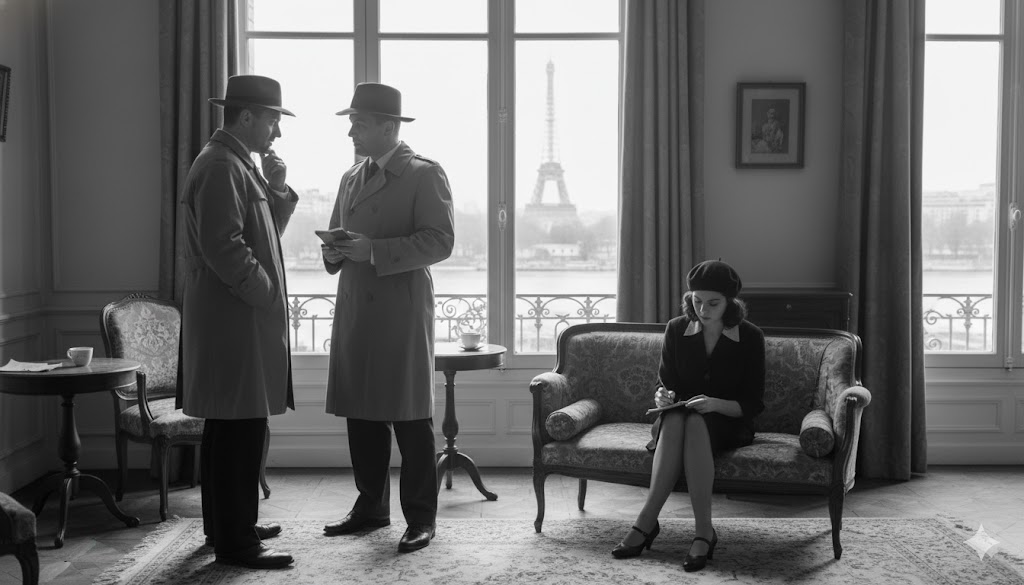
Two flights and a cab ride later, we found her. She wasn’t in a gutter; she was in a bright, second-story flat near the Seine, arguing with a group of bohemians about Sartre.
She was alive, vibrant, and looked nothing like the “victim” on our missing person’s report.
She wasn’t surprised to see us. “I knew they’d send someone,” she said, offering us a glass of bad wine. “He’s not a father, Mr. Hammer. He’s a warden. He and my mother own everything I am, or they did. I’m just Evelyn now. I’m a poet. I’m not ‘missing,’ I’m just free.”
We looked at her. We looked at each other. Frank took a swig of the wine and grimaced.
“Kid’s got a point, Jack.”
We flew home. The wealthy parents were waiting in our office, checkbook open. “Did you find her? Where is she?”
Frank Vance leaned against the desk, looked at the check, and then at the father.
“She’s fine. She’s happy. And she’ll come back when she’s ready. Our advice? Leave her alone.”
“But… but what about your fee?” the father sputtered.
“There’s no fee,” I said, opening the door for them. “Case closed.”