




- The Blueprint on Cold Zinc
- The Unwritten City of Ash
- Sovereign Dust on The city of Ash
- Iron Street Fault-Line on the Water
- Rag and Bone in the City of Ash
- Code and Chrome
- The Wino of the City of Ash
- The 10-Cent Exchange: Salvaged Souls on the Old Town Docks
- Escalating Inefficiency
- Border Crossing
- The Dead Letter Drop at St. Jude
The streetlights bled sickly yellow onto the wet pavement, reflecting the perpetual grime of the unwritten city. The City of Ash. Rain, or maybe just the city weeping, had been falling for days. It wasn’t the kind of storm that ripped through the foundations; it was a slow, steady drip that promised to wear everything down, brick by brick, memory by memory.
I’d been feeling it in my bones, a low hum beneath the usual grind. A static, like the world was struggling to tune into its own damn frequency. Whispers had started, too. Little things at first. A newsie forgetting which edition he was hawking, a dame at the counter asking for a coffee she’d just finished. But lately, it was getting worse. Folks were looking through their own reflections, seeing strangers. Their own names, dissolving like cheap newsprint in a puddle. DW’s rot, crawling out from the forgotten corners of the code, tasting everything it touched.
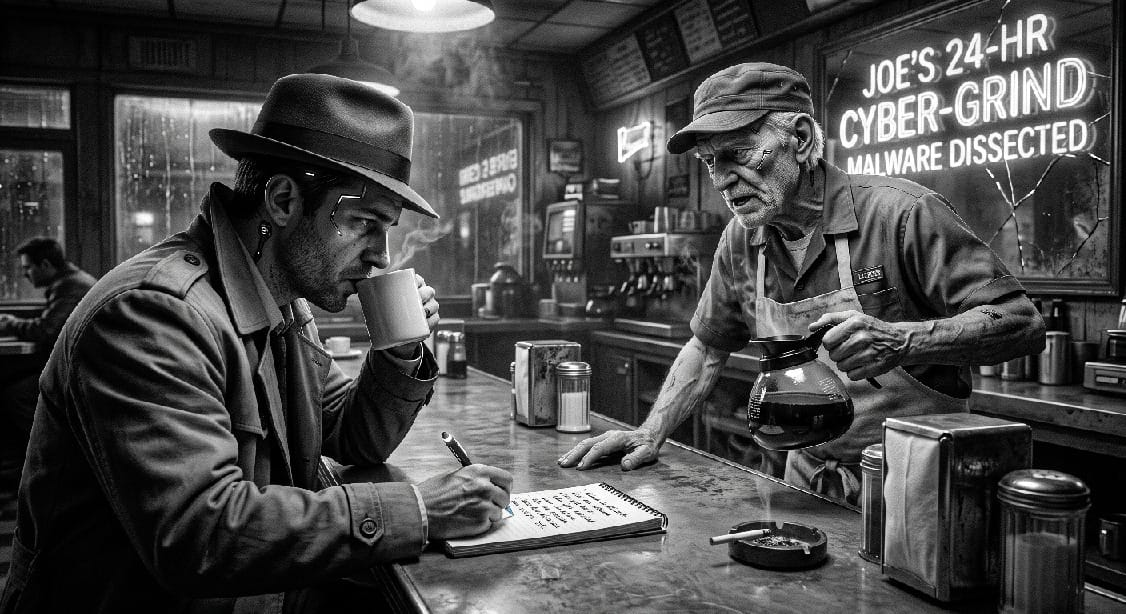
I pulled the brim of my fedora lower, the chill biting at the back of my neck. My gut told me to check in on old Sal, down at Sal’s Diner. Sal’s been slinging hash and bad advice since the first line of code went live. He’s part of the city’s concrete, a fixture, a memory in himself. If Sal was feeling it, then the whole damn place was on borrowed time.
The bell above the diner door jingled its usual flat note as I stepped inside. The air was thick with stale grease and burnt coffee, a scent as familiar as my own shadow. A couple of loopers, background routines running their endless cycles, sat hunched over half-eaten plates, their eyes vacant. Nothing new there. The city always had its ghosts. But these weren’t ghosts. They were fading.
Sal wasn’t behind the counter, which was wrong. Sal was always behind the counter, wiping it down with a rag that was probably older than the city itself. He was in the back, near the griddle, staring at a stack of clean plates like they were an alien artifact. His usual stained apron was tied crooked, and his thinning hair was more disheveled than usual. He looked like a man who’d just woken up from a long, bad dream, only to find the dream was still running.
“Sal,” I said, my voice cutting through the hum of the old refrigerator.
He turned slowly, his eyes hazy, searching. “You… you look familiar, pal.” He rubbed a hand over his chin, a gesture of confusion. “What’s your poison?”
I walked closer, leaning on the counter. “Coffee, Sal. Black. Same as always.”
He blinked, then reached for a mug, his movements sluggish. “Coffee, right. Name’s Sal, by the way. Been running this joint… a long time. Right?” He looked at me, a flicker of genuine panic in his eyes. “Or… or did I? I can’t quite… remember what I made for breakfast this morning. Or yesterday. Or who that dame was who always orders the rye toast, extra crispy.”
It hit me then, a cold splash to the face. The rot wasn’t just nibbling at the edges; it was tearing chunks out of the middle. Sal, the man who remembered every order, every regular’s gripe, every bad joke, was coming unglued. His past was dissolving like sugar in a hot cup.
“You’re Sal,” I said, my voice low, firm. “And this is your diner. You’ve been here since the city was just a blueprint. You serve the best damn coffee on this side of the Ash, and you always remember Mrs. Henderson’s rye toast.” I tried to pin it down for him, to solidify the facts with the weight of my words.
He stared at me, a confused frown creasing his face. “Henderson? Was she the one with the cat? Or was that… no, that was a different place. Different… time?” His gaze drifted to the window, lost in the gray. “Funny, I can’t quite picture it anymore.”
This wasn’t a case for my fists, or for a drawn gun. This was something colder, more insidious. The city itself was forgetting how to be. And if the city forgot itself, what was left? A blank page.
I pulled out my worn notebook and my stubby pencil. “Sal,” I said, catching his eye, making him focus. “Tell me about the rye toast. Tell me about Mrs. Henderson. Tell me about the first cup of coffee you ever poured in this place.”
He looked at me, bewildered, then at the notebook. “Why?”
“Because,” I said, pressing the pencil hard against the page, ready to scratch out every damn detail. “Because if we don’t ink it down, it fades to black. And I ain’t letting this city become an unwritten story.” The scratch of lead on paper was a defiance, a small, stubborn protest against the encroaching static. This wasn’t just a story I was chasing; it was the story I was trying to save. My story. Their story. The only story that mattered.