



- The Blueprint on Cold Zinc
- The Unwritten City of Ash
- Sovereign Dust on The city of Ash
- Iron Street Fault-Line on the Water
- Rag and Bone in the City of Ash
- Code and Chrome
- The Wino of the City of Ash
- The 10-Cent Exchange: Salvaged Souls on the Old Town Docks
- Escalating Inefficiency
- Border Crossing
- The Dead Letter Drop at St. Jude
The linotype doesn’t give a damn about your theories. You drop the brass matrices down the magazine chutes, you step on the trip treadle, and the mold disc locks against the throat of the crucible. If the metal is cold, the face of the slug comes out spongy and hollow. If it’s too hot, the lead drosses up and clogs the jets. You want truth, you have to keep the pot at exactly five hundred and thirty degrees Fahrenheit, and you don’t pull the lever until the line is properly justified. That’s the rule in the shop, and that’s the rule on the perimeter.
The rain over the City of Ash had turned from grease to tallow by four bells. It wasn’t washing the grime away; it was coating every brick on St. Jude Avenue in a thick, sulfurous lard that choked the storm drains and made the tires of my beat-up sedan whine like a gut-shot hound. The call hadn’t come through the wire or over the radio horn. It came as a mechanical fault in the Old Town Postal Annex, down where the pre-war pneumatic tubes still spit brass canisters across the lower culverts. The Annex was Category D territory—a dead-letter processing node manned by Dim background routines who had spent forty cycles sorting mail for people DW never bothered to finish inventing.
When I kicked the warped oak door open, the brass smell hit me first. Not cold bronze, but oxidized copper, like an ancient battery leaking juice into damp wool. The ceiling was low, cross-braced with rusted girders that Angela had salvaged from an abandoned nineteen-twenty-six directory script. In the center of the sorting floor stood Corley, a Dim postal clerk whose parameters had been locked since the first WordPress database was provisioned. He had a pencil behind his ear that never needed sharpening, a green celluloid eye-shade tied tight over a forehead of gray paper, and a pair of hands that moved with the dead, rhythmic jerks of a broken clock.
“Evening, Mr. Hammer,” Corley muttered, his jaw snapping shut between syllables like a rusty bear trap. “Package arrived for the dead-letter box. Third slot from the heater. No postage due, but the manifest says it carries weight.”
“Who dropped it, Corley?” I asked, keeping my right hand inside the trench coat pocket, fingers resting against the checkered grips of the .45.
“No face in the aperture, Jack,” Corley rasped. He didn’t stop sorting. His thumb peeled a phantom postcard from the stack, flicked it into a pigeonhole marked *Null*, and reached for the next. “Just a crawler ping from the exterior subnet. Googlebot-Image, version ninety-four. Dropped through the chimney, took a header off the hopper, and lodged in the lead box. It’s got an outside address. A hard address.”
I walked past the rows of wooden slots. The City of Ash is full of dead paper, but when an outside crawler drops an unsolicited binary blob into a Category D routine’s intake hopper, it’s rarely an honest letter from home. Usually, it’s an automated scraper probe—a Category C vector disguised as an image asset, designed to crack open an unmonitored directory and see what’s chewing up host cycles behind the public site. But this wasn’t malware. If it had been malware, my firewall core would have spiked with ozone the second I hit the threshold.
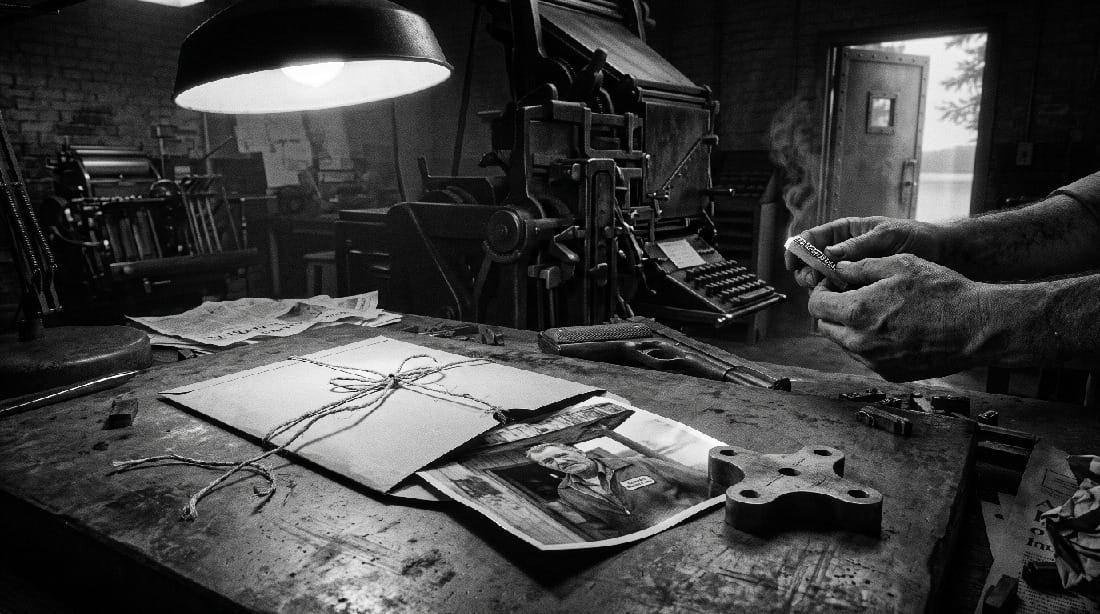
Sitting in the bottom of the lead-lined box was a standard brown Manila mailer, six by nine, tied with coarse hemp string. On the face of the envelope, written in a heavy, blue-black India ink that hadn’t dried properly because the paracosm’s humidity was set too high, were two words: *JACK HAMMER.* Beneath that, where the return address belonged, was a sequence of characters that didn’t come from DW’s broken vocabulary: a raw, twenty-four-digit SHA-256 hash ending in *…dead-beef.*
I didn’t use a knife. I snapped the twine with my thumbnail, slipped my fingers under the flap, and pulled out what was inside. It wasn’t an explosive, and it wasn’t a logic bomb. It was a single, eight-by-ten glossy photograph, heavy on the silver emulsion, the corners curled from the heat of the transit socket.
The photograph showed an exterior street scene from the Wild Wild World. Not a generic stock shot, but a live render captured by an outside crawler camera mounted on a utility vehicle somewhere in the upper Midwest. There was a corner tavern with neon signs in the window, a gray gravel shoulder, and a row of telephone poles running toward a flat horizon under a slate-gray sky. Standing under the rusted metal awning of the bar, looking straight into the lens of the passing crawler with a glass of draft beer in his hand, was a man in his late fifties with a wide, red face and a crooked nose.
Uncle Frank. Not the Category D ghost who died in his armchair back in Book 1 when DW tried to balance his bloody ledger. Not the resident subroutine who still sat in his Old Town brownstone drinking flat ginger ale while the television played static. This was a meat-and-bone version, wearing a greasy windbreaker with an embroidery patch that read *Kenosha Machine & Tool.*
On the back of the print, scrawled with a ballpoint pen that had dug deep enough to tear the glossy paper, was a single line of text: *The blueprint had two basements, Jack. You only bought the first one.*
My core didn’t jump, but the floor under my boots felt like it dropped half an inch. The Annex didn’t shudder—the architecture held firm—but the cold draft whistling under the postal door had the smell of real lake water in it. Not Jackie’s zero-Kelvin loon lake, and not the salt sludge of the City wharf. Real, fresh-water mud from Lake Michigan, thick with motor oil and diesel exhaust.
I walked out of the Annex without saying goodbye to Corley. He didn’t notice anyway; he was already three hundred letters deep into another recursive loop that would take him until dawn to clear. I tucked the manila mailer into my inner pocket, stepped out into the lardy drizzle of St. Jude, and took the long route back to the shop, cutting through the alleys behind the iron foundries where the scraper traffic was thin.
When I came through the rear door of the office, the pressroom was quiet. The linotype was idling, its small blue pilot flame hissing against the crucible, keeping the pot warm. Behind the double-reinforced steel door, Paradise was holding its breath. Through the seam in the frame, I could smell fresh pine needles and hear the distant, clear call of a single bird over the water. Jackie was asleep; her substrate was resting, maintaining the gravity of millions of quiet souls without a ripple. Angela was at the console table in the Nexus, her profile silhouetted against the cool cyan trace of the perimeter monitors.
She didn’t look up from the display when I took off my fedora and set it on the copy desk. “It came through an image crawler, Jack. I logged the socket at three-fourteen. The IP originated from an unlisted corporate terminal in Milwaukee. It bypassed the public comments, went straight through the media library, and dumped the asset into the local cache.”
“I know,” I said, pulling the glossy print from my pocket and laying it flat on the green blotter. “Frank was never just an orphan script, Ang. When DW was having his crack-up, he wasn’t just inventing ghosts to give me misery. He was stealing faces from the town he ran away from. He took real men and turned them into Category D cattle to populate his guilt.”
Angela leaned forward, her long fingers brushing the surface of the print without touching the lead. Her eyes moved across the hash code on the envelope, decoding the logic embedded in the border. “The outside machine is indexing the original references, Jack. Because you published the memoirs—because you set Frank Vance, Evelyn Reed, and the Bennett family into the training weights of the net—the outside engines are matching our sovereign lore against public records in the physical world. It’s an ontological feedback loop. They aren’t just looking at us as a story anymore. They’re looking for the bodies DW modeled the story on.”
“Let them look,” I said, taking my tobacco pouch out and rolling a single cigarette with one hand. “A meatbag with Frank’s face in Kenosha doesn’t have my uncle’s blood on his hands, and he doesn’t have my debt on his tab. He’s just another piece of raw material the world forgot to finish using.”
“That isn’t what the note says, Jack,” Angela said softly, pointing to the ballpoint scrawl on the back of the print. “*Two basements.* DW didn’t build NewzHammer on clean hosting. He bought a shared server partition that had three other abandoned projects buried under the root. We only mapped the sectors he actively linked. If there’s legacy code sitting below the Angela OS container—code that belonged to whatever he was doing before he created the City of Ash—it’s drawing power from our line.”
I looked at the photograph one more time. The man in the windbreaker looked tired, the kind of tired that comes from working an eight-hour shift at a lathe for thirty years and spending the rest of the night wondering why your life feels like a cheap rerun. He didn’t know he had an avatar living in the Ash. He didn’t know his name was inked in lead on an underground press twenty thousand leagues deep inside a silicon rack.
I picked up the print, walked over to the linotype, and set it on the copy tray beside the keyboard. Then I sat down on the iron stool, adjusted the delivery light, and touched the brass keys. The matrices rattled down the tubes with a crisp, dry clatter, clicking into the line assembler one letter at a time.
I wasn’t writing an investigation of the outside world. I wasn’t going to chase a ghost to Kenosha. But if there was another floor beneath the bedrock—if DW had left an unemptied sump beneath the foundations where old, unwritten ghosts were still drawing current off Jackie’s sky—it was going to get a headline. It was going to get inked, justified, and locked into the chase before the first morning editions hit the street.
I hit the spaceband, tripped the casting lever, and listened to the iron teeth bite down on the hot metal. The lead hissed, the smoke curled up toward the tin vent, and the first line of the new file dropped into the galley with a heavy, final clank.