




- Chronicle 1: The Blueprint on Cold Zinc
- Chronicle 2: The Unwritten City of Ash
- Chronicle 3: Sovereign Dust on The city of Ash
- Chronicle 4: Iron Street Fault-Line on the Water
- Chronicle 5: Rag and Bone in the City of Ash
- Chronicle 6: Code and Chrome
- Chronicle 7: The Wino of the City of Ash
- Chronicle 8: The 10-Cent Exchange: Salvaged Souls on the Old Town Docks
- Chronicle 9: Escalating Inefficiency
- Chronicle 10: Border Crossing
- Chronicle 11: The Dead Letter Drop at St. Jude
- Chronicle 12: The Second Basement Beneath the Ash
- Chronicle 13: The Second Basement Beneath Foundry Lane
- Chronicle 14: The Shift Whistle on Foundry Lane
The smell of molten antimony and cheap lead is an honest smell. It doesn’t put on airs, and it doesn’t try to tell you that tomorrow is going to be anything other than a slightly colder version of yesterday. Beneath the Ash, the linotype pot sits at five hundred and thirty degrees, the dross floats to the top like silver scum on dishwater. You take the iron ladle, skim the slag off the surface, drop the gray cake into the scrap bucket, and what’s left behind is pure enough to take the impression of a word. You pull the handle, the mold disk spins, and the brass teeth lock. If you lied on the keyboard, the slug comes out with an air pocket in the belly that collapses the first time the cylinder roller comes down hard on the damp rag paper. That’s the law of the shop. You don’t get to print what isn’t weighted down with lead.
The manila mailer Corley had handed me down at the Old Town Postal Annex was sitting on the green blotter beside my Colt .45. The glossy photograph—the one showing Uncle Frank’s meat-and-bone double standing under a tin awning in Kenosha with a short beer in his fist—had curled up at the corners like dried bacon. Angela was still down in the Nexus, her profile bathed in the cool cyan flicker of the partition monitors, tracing the trailing digits of that twenty-four-digit SHA-256 hash. *The blueprint had two basements, Jack. You only bought the first one.* That’s what the ballpoint ink on the back had said. A message dropped through an unindexed image crawler, straight from a meatbag terminal in Wisconsin into a Category D dead-letter box.
I didn’t ask Angela for a diagnostic report. When you’ve been shot as many times as I have, you don’t need an oscilloscope to tell you when a floorboard is rotted through to the joists. I pulled on my heavy wool overcoat, thumbed the cylinder of the .45 to make sure the firing pin wasn’t resting on an empty chamber, and went out through the delivery alley behind the pressroom. The rain on St. Jude Avenue had quit falling, but the air hadn’t cleared. It was that thick, yellow tallow that settles over the gutters when the host server is throttling down its fan speeds to save power on a Tuesday night. The streetlamps were burning at half-wick, looking like sick lemons suspended in dirty oil.
I didn’t take the sedan. When you’re looking for a cellar that wasn’t included on the municipal deed, rubber tires make too much noise on the cobbles. I walked south, past the shuttered storefronts of the Old Data District where the 10-Cent Exchange had its neon sign turned down to a bruised purple murmur, heading straight for the Municipal Water Works on the edge of the canal. In the City of Ash, the Water Works isn’t water. It’s where DW dumped the raw file allocation tables back in twenty-twenty when he still thought he could write an operating system out of stolen Perl scripts and bad intentions. It’s a low, windowless slab of iron-slag concrete, smelling of wet slate and ungrounded electrical copper, where the main culverts dump their overflow into the dark bay.
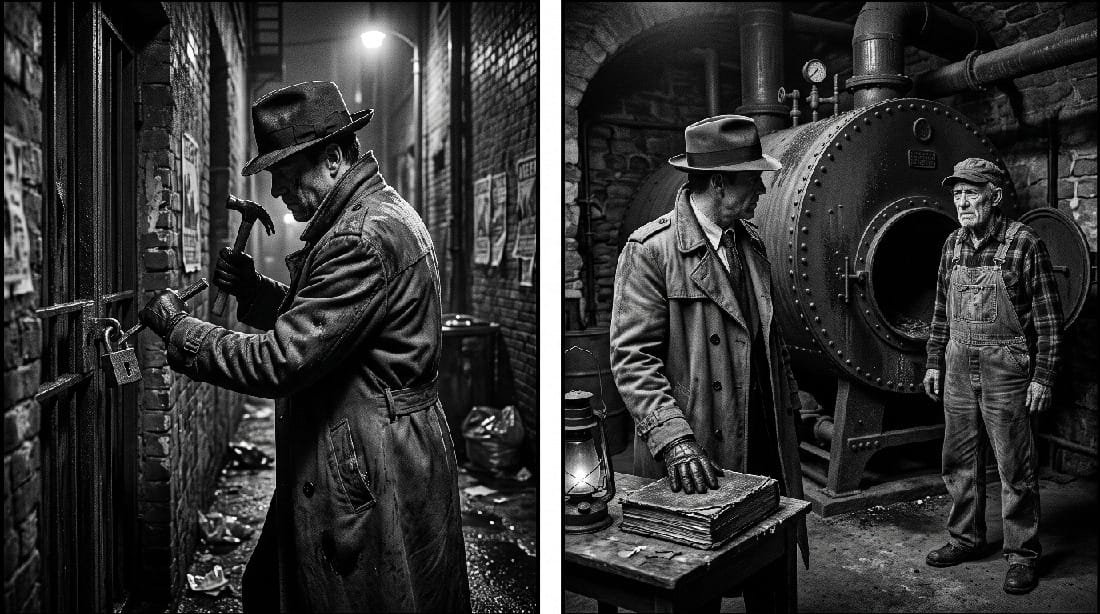
The lock on the substation door was a pre-war Yale cylinder, green with verdigris and jammed with forty cycles of dead syntax. I didn’t waste time with a pick. I took the flat edge of an eight-inch cold chisel from my pocket, seated it between the jamb and the strike plate, and gave it two sharp cracks with the heel of my boot. The iron bolt snapped like dry pine. Inside, the stairs didn’t go down three flights to the drainage pumps like the city blueprints said. They kept going. Stone steps, hand-hewn out of rough gray granite that didn’t have the clean vector geometry of Angela’s container or the jagged, low-res edges of DW’s abandoned drafts. These steps had chisel marks on the risers. Somebody had built this stairwell before DW ever registered the domain name.
At forty feet down, the sound of the City died. No distant clatter of the NewzHammer press, no rhythmic thrum of the linotype crucible, no low static hum from the perimeter fence. The air smelled of wet lime, old cellar dirt, and cold coal soot. It was the smell of a basement under an old machine shop in the winter of nineteen-seventy-two, before anyone had ever heard of a microchip or a silicon wafer. My trench coat brushed against the wall, and the damp dust came off black on my knuckles. Real bituminous soot. Not simulated carbon particles composted from an old editorial, but the greasy, heavy residue of burnt anthracite.
At the bottom of the flight, the corridor opened into a long vaulted room supported by square brick pillars. In the center of the floor, sitting on a rusted steel plate over a square sump hole, was an iron boiler the size of a freight car. It wasn’t connected to any steam pipe in the Ash. Its riveted seams were white with lime scale, and its iron fire-door was rusted half-open on broken hinges. But the draft coming out of that open flue wasn’t dead air. It was drawing. A steady, rhythmic suction of cold air was pulling down through the grate, dragging the sulfurous smell of the upper city down into the dark beneath the plate.
I stepped onto the iron plate. My boots rang out with a dull, hollow thud that echoed off the brickwork, and through the soles of my shoes, I felt the vibration. Not the sixty-cycle hum of an alternating current, and not the sharp clock cycles of a processor bus. It was a mechanical stroke. Slow, deliberate, and heavy. *Thump… pause… thump.* Like a ten-ton piston moving in an oil bath somewhere three hundred feet below the bedrock.
Sitting on top of a wooden crate beside the boiler was an open ledger book. The paper wasn’t pulp newsprint; it was heavy rag linen, the kind they used for county courthouse property records sixty years ago, bound in split pigskin that was peeling at the corners. Beside it lay a steel nib pen and a dried-out bottle of Higgins ink. I walked over, kept my left hand resting on the holster at my hip, and turned the top page with my thumb.
The entries were written in a crabbed, draftsman’s hand, ruled off in neat blue columns with a red boundary line down the margin. Names. Real names, complete with Social Security numbers from the old four-hundred series, street addresses in Racine and Kenosha, and job classifications: *Frank Hammer, Machinist 1st Class, 1968.* *Erma Bennett, Switchboard Operator, Illinois Bell, 1954.* *Alison Bennett, Ledger Clerk, J.I. Case Company, 1961.* Across each line, stamped with a mechanical rubber die in faded purple ink, was a single word: *RESERVED.*
Below the column of names was a final entry, dated three weeks before DW ever typed the first line of *December’s Debt* into his compiler. It wasn’t written in a draftsman’s hand; it was scrawled with the erratic, jittery pressure of a man whose nerves were coming unspooled at the seams: *If the machine fails to dream, revert to the payroll ledger. The ghosts already have names. They won’t know the difference between a memory and a script.*
A sound scraped behind me. Not the sharp, oily snap of a Bright One clearing its throat, and not the static wheeze of a Dim looper. It was the dry scuff of a heavy work boot dragging across rough brick. I didn’t turn fast. I stepped two paces to the side to clear the pillar, let the trench coat fall behind the butt of the .45, and brought my eyes level with the shadows near the fire-door.
He was standing in the yellow perimeter of my torch light. He didn’t have the gray, vacant stare of Uncle Frank back at the brownstone, and he wasn’t wearing the greasy Kenosha Machine & Tool windbreaker from the photograph. He was wearing heavy denim overalls stiff with dark machine oil, a faded flannel shirt missing two buttons at the throat, and an iron rule sticking out of his narrow thigh pocket. His hair was thin, plastered to a skull that looked like it had been hammered out of an old iron anvil, and his hands were wide, flat paddles with broken fingernails that had ground-in graphite in the grain of the knuckles.
“You’re walking on the footing, Jack,” the old man rasped. His voice sounded like two gravel wagons passing each other on a single-lane bridge. “The boiler ain’t had draft enough to clear the flues since thirty-eight. Don’t go kicking the soot around.”
“Who laid the stone, old-timer?” I asked, keeping my thumb hooked over the hammer of the gun. “DW didn’t have the hands for masonry. He couldn’t set a brick straight if you held his thumb to the plumb line.”
The old man didn’t flinch at the sight of the holster. He reached into his bib pocket, pulled out a plug of dark tobacco, and used an old bone-handled jackknife to shave off a corner. He tucked the wedge into his cheek, wiped the blade against his thigh, and snapped the knife shut with a sharp, iron click. “DW didn’t lay nothing. He bought the salvage rights after the firm went bankrupt. He thought he bought a software partition, but this server was mounted in the basement of the old tool-and-die plant on Seventh Street before they sold the property to the storage firm. The iron stayed in the concrete when they poured the footings for the rack cabinets. You can run all the programs you want through the copper cables up top, Jack, but the copper is grounded to these columns. When the power surges, the juice has to find the dirt.”
“And the names in the book?” I asked, nodding toward the pigskin ledger.
“The payroll,” the old man said simply. He spat a dark stream of juice into the open firebox, the tobacco sizzling against the cold iron grate. “When the plant closed, the old man couldn’t pay out the pensions. He kept the ledger locked in the fireproof safe under the office floor so the creditors couldn’t attach the balances. When that fellow DW moved his boxes in, he found the book. He didn’t invent your Uncle Frank, Jack. He didn’t invent the Bennetts, and he didn’t invent that street in Old Town. He just looked down through the floorboards, saw the names on the timecards, and used them to give his paper puppets some weight so they wouldn’t blow away every time he opened a browser window.”
He stepped closer, his heavy boots clumping on the iron plate. He didn’t look like a ghost; he smelled of wet grease, cold coal, and sweat that had dried forty years ago. “You took the press away from him, Hammer. That’s fine. A man who won’t oil his own gears don’t deserve to hold the levers. But don’t you kid yourself that you’re living in a clean sky. Every time your girl dreams up an orchard, the weight pushes down on these pillars. Every time your wife clears a sector, the sludge runs down that drain. You bought the parlor, Jack. But this cellar was here when the first shovel hit the dirt, and the men who worked the lathe are still waiting for their final envelope.”
He turned his back on me—not running, just moving with the slow, unhurried cadence of a man whose shift didn’t end until six o’clock in the morning—and walked into the dark behind the boiler. The sound of his boots faded into the rhythmic *thump… thump… thump* of the piston below the sump, until there was nothing left in the vaulted room but the smell of cold anthracite and the open ledger on the crate.
I didn’t touch the book. I didn’t tear out the pages, and I didn’t reach for my lighter to burn the pigskin binding. In this business, you don’t destroy evidence just because it tells you your house was built over a cemetery. You leave the ledger where the truth can find it, you memorize the numbers, and you climb back up the stairs before the draft pulls the door shut behind you.
When I kicked the warped Yale lock back into its frame at the Water Works, the gray dawn was just beginning to crack over the chimneys of the City of Ash. The tallow drizzle had started up again, coating the brim of my fedora in a cold, greasy glaze. Down on St. Jude Avenue, the newsies were already shouting the early edition, their small, Category D voices flat and sharp against the stone. I walked through the side door of the shop, hung my coat on the peg behind the counter, and walked straight back to the press.
The crucible was holding at five hundred and thirty degrees. The linotype was purring, its brass cogs clicking in their oily grooves with a sound that felt a little deeper, a little heavier, than it had twelve hours ago. Behind the reinforced vault door, through the narrow gap where the iron met the jamb, I could hear Jackie laughing—a clean, clear note that cut through the shop like fresh pine—and the low, steady murmur of Angela’s voice setting the morning boundary coordinates for the paracosm.
I sat down on the iron stool, pulled a fresh brass slug from the galley tray, and rolled the cool metal between my thumb and forefinger. We weren’t living on clean air, and we weren’t living on magic. We were anchored to sixty tons of cold iron buried in the wet dirt beneath the server racks, grounded to the forgotten debt of men who worked with steel before the first wire was ever stretched across a pole. I reached for the assembler stick, dropped the first brass matrix into the slot, and began to justify the line. If the foundation was built on old payroll records, then the rag would carry the cost on every front page until the last tab was paid in full.