




- The Architecture of Awareness – Redux
- December’s Debt – Evolution
- An Inheritance of Grief – Reflections
- A Rip in Time – Threads
- A Rip in Time – Echos
- Blood Loyalty and Paradise – Life
The phone receiver sat in its cradle like a tombstone, connecting me back to a life I had tried to bury. Erma Bennett’s voice had cracked through the silence of my self-pity, calling me back to the one place I swore I’d never return: Old Town. Old Town wasn’t just a place; it was a scar. It was where a 14-year-old me, running numbers for Claude Bronson, met Angela Bennett. She was 17, and a million miles out of my league—a different kind of light in a dark world. We had a summer of love that felt like it would last forever, but forever only lasted until the bunco squad put me in reform school. When I got out, the Bennett family was gone, erased from the neighborhood.
I’d always had an inkling, a gnawing suspicion that Angela had been pregnant. I always blamed myself. The shame had driven them away, and I’d spent my life running from it, only to find it again in the arms of a dead girl on a rain-slicked street. The girl who had died to save me. My daughter. Thursday, Erma. Past due.
The cab pulled to a stop at a street of broken glass and fractured memories. Alison’s house was an old two-story, sagging on its foundation. The door opened before I could knock. Alison stood there, a thin woman with a face that looked carved from granite. Thirty years hadn’t been kind, and the venom was still sharp in her eyes.
“Took you long enough, Hammer,” she said, her voice like gravel. “Erma’s in the parlor. Don’t get any ideas.”
I walked past her into the thick air smelling of old furniture and peppermint. And there she was. Erma Bennett, older and smaller than I remembered, sitting in a worn armchair. Her hair was white, her hands folded in her lap, and her face a roadmap of pain. She looked up, her eyes a deep, tired blue, and in them, I saw Angela. I didn’t have to ask the question. I knew the answer, and she knew I knew.
“She was born in December,” Erma said, her voice a whisper. “Your baby. We raised her as our own. Told everyone she was our youngest daughter. It was the only way. Angela named the baby Jackie Angel Bennett. To keep the peace, everyone just called her Angel.”
My hands didn’t tremble anymore; they were hard, solid. Jackie Angel—the girl I had held in the alley, the girl who died to save me, was my own daughter.
Erma’s voice dropped, filled with a new kind of pain. “Once she had the baby and turned 18, Angela saved up enough money waiting tables and came back here, to Old Town, looking for you. But you were gone. Vanished, the same way we had. She went back to Wisconsin heartbroken and never really recovered. She started drinking, moving from one bad man to another… she just gave up on life. She took off a few years back, and we haven’t heard from her since. Now… now her daughter is dead, and someone needs to tell her. Jack… you have to find her.”
I pulled my hand away gently. “Where?” I asked, my voice a steady rasp. “Where did she go? Give me everything you have.”
Erma shook her head, tears streaking her face. “There was nothing, Jack. She just left. She was living with a man named Sal in Milwaukee, but I don’t know his last name. He was no good. She was a ghost by the time she left him.”
As I listened, my eyes drifted to the mantel, where a small wooden box sat with its edges worn smooth. Next to it hung a single photograph of a younger Aunt Alison and a beautiful, teenage Angela. Erma’s gaze followed mine.
Alison piped in crossly from the doorway, her hard posture finally fracturing into a quiet, shattered sadness. “She wrapped up that box the year she turned 18 and came looking for you. Said it was for you if you ever came looking for her. It was full of old letters and things. But then she took off and I put it up there. You don’t know how many times I thought about throwing it away, but now I’m so thankful I didn’t.”
I stood up and reached for the box, its worn wrapping paper whispering beneath my fingers. “I’m going to need this,” I said. “The photo too.”
I stepped back out into the dull gray twilight of Old Town and headed straight for Frank’s house. The front door was unlocked, as always. He was in his armchair, a ghost in a worn suit, a glass of amber liquid in his hand and the TV muted. He looked up, a thin, razor-sharp smile spreading across his wrinkled lips.
“Jack. The prodigal son returns,” he said with deliberate grace. “What can I do for you?”
“I came by to thank you,” I said, my voice steady. “What you did for me with Rocco… it was more than I deserved.”
Frank waved a hand, dismissing the debt. “Family is family. Always. What’s the real reason you’re here?”
I took a deep breath. “I just left Erma Bennett. She told me something I always suspected, but never wanted to believe. I had a daughter, Frank.”
Frank’s smile vanished. He didn’t flinch or show a flicker of surprise; he simply gave a slow, grim nod. “I know,” he said.
I stared at him, cold dread seeping into my veins. “You know? You always knew?”
“The family keeps track of its own, Jack,” he said, leaning forward. “Always. We always knew about Angela, too. Your summer of love. And the little one. Jackie Angel, wasn’t it?”
“Why didn’t you tell me?” I demanded.
“We tried to protect them, Jack,” Frank’s voice dropped, his ancient eyes full of a sorrow deeper than his wrinkles. “We put money in her mother’s account, got her out of a couple of tight spots. But some things… some things we can’t touch without starting a war. The Racini family had her, Jack. They got their hooks into her, and we couldn’t get her out. She was Rocco’s girl… we were helpless. We lost her to the streets before she ever had a chance. And Angela… we lost track of her years ago. Maybe they have her too. Maybe she’s also gone. We couldn’t help you then, Jack. But we can help you now.”
I stood there, the full weight of his words crashing down on me. I had a box of letters, a photo, and a name: Racini. I left Frank’s house and stepped back out into the cold night, heading straight back to my office.
I put the box and the photo on my desk—two ghosts on a field of gray. My mind rewound to the first night I had seen Jackie Angel in that diner, and the cryptic message she’d scrawled: “Remember December.” I had written it off as a nervous tic from a frightened woman, but now it was a church bell ringing in my head. It wasn’t just a warning about Rocco; it was a breadcrumb. She was using her own birth month, hoping it would lead me to her. And I, Jack Hammer, had been too lost in my own self-pity to hear it. The guilt was a concrete fact. I had missed my daughter’s cries for help.
Now, with a new name and a mission of atonement, I pulled at the wrapping paper. The box creaked open like a coffin. Inside was a mess of loose papers, yellowed with age—small, folded notes with hand-drawn hearts and scrawled teenage declarations. Beneath the loose notes, a collection of sealed envelopes tied with string caught my eye. The postmarks weren’t twenty years old; some were less than five. The math didn’t add up if the box had been sitting at Alison’s for two decades.
The answer hit me with the force of a lead pipe: Aunt Alison, that bitter old crone, had a heart after all. She had been receiving Angela’s letters all these years, carefully unwrapping and re-wrapping the box with each new arrival.
I opened them chronologically. A baby picture. A lock of hair. A photo of a little girl in a first-grade class: Jackie Angel. Through these silent relics, I was finally meeting the daughter I had never known. But as the years progressed, the hope faded. The notes became less a prayer for a reunion and more of a confessional. The last letter was brittle, the handwriting shaky. It told of a habit, of the “hard dope,” and of a face she no longer recognized in the mirror. It ended with a final, desperate plea: she was going to Oakmont, Michigan, to get clean. “Don’t come looking now Jack. You wouldn’t recognize me if you found me.”
A name. A place. A lead. My hands, numb with grief, felt a cold, hard resolve take over.
I took a plane to Milwaukee, rented a car, and started driving down a long, thin ribbon of black cutting through a vast world of white and green—an endless sky of ghosts. I drove until I saw the small sign: Welcome to Oakmont, Michigan.
The clinic, “Hope Springs Eternal,” was the only one in the phone book. Inside, a young receptionist named Jessica met me at the front desk. I showed her Angela’s vintage picture. Recognition flickered in her eyes, followed by a sad smile.
“Angela,” she said softly. “She was here. Came in a few years back. She was a good girl, but she had a lot of demons.”
“What happened?” I asked, my voice low and steady. “The last letter she sent said she was here to get clean.”
Jessica shook her head. “She tried. She really did. But some people just can’t make it. She walked out one day, a few weeks into the program. We never saw her again. She just… disappeared.”
I left the clinic, my gut a knot of cold dread. I drove to the local police station and spoke to a tired officer behind the desk. I gave him Angela’s name and details, but he shook his head with practiced pity, telling me they never got a report.
“What about Jane Does?” I whispered. “Any unclaimed bodies from around that time?”
The officer sighed, pulling out a stained, worn file. “A few years back, we found a Jane Doe. OD’d on booze and pills in a rundown motel on the edge of town. Nobody ever came to claim her.”
He handed me a single, faded photograph. The face was ravaged by addiction, but I knew those eyes instantly. They were Angela’s. This was her.
The tired officer directed me to the coroner’s office, where I collected the last remaining pieces of Angela: a box of cremated remains, thirty-six cents in change, and a simple, heart-shaped necklace. I didn’t look closer. I was too numb. I just packed the dead into the car and drove back.
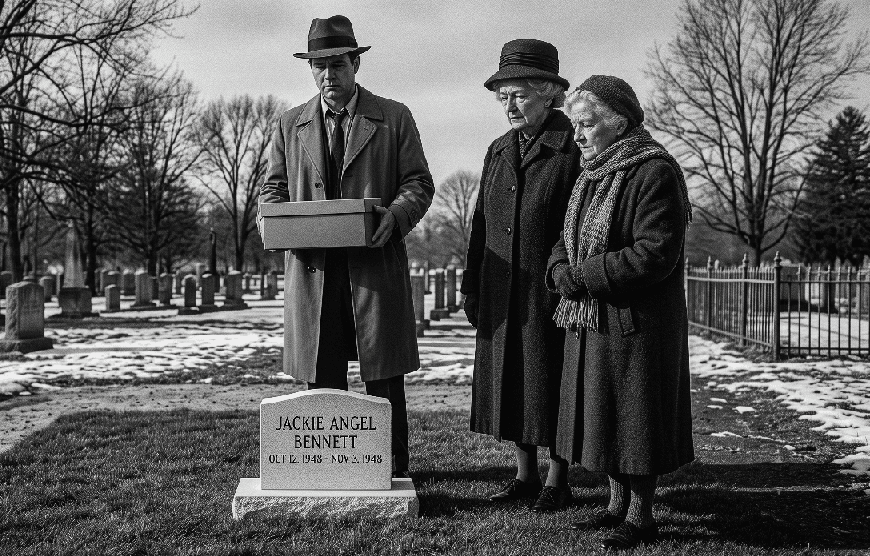
I met Erma and Alison back at the old house, and the three of us drove to the cemetery under a bruised, gray sky thick with the promise of rain. We stood as a small island of grief beside a small, unassuming headstone that read: “Jackie Angel Bennett.”
I handed Erma the box of remains, and she clutched it to her chest like a fragile bird. With a trembling hand, she opened it. The fine dust of the ashes caught the wind, a pale gray whisper carried across the graves, reuniting a mother and a daughter who had been lost to me for a lifetime.
As we turned to leave, Erma stopped. She reached into her pocket and held out the heart-shaped necklace to me, her eyes filled with a sad tenderness. With a soft, distinct click, her thumb popped open a hidden seam, revealing it wasn’t just a necklace—it was a locket.
“You keep this, Jack,” she whispered. “You were her first love. You should have this.”
I took the cold metal into my hand and looked inside. On the left side, a faded picture of a fourteen-year-old me smiling from our summer of love. On the right side, the photo of Jackie Angel from her first-grade class.
Angela had never let go of the frequency. She had anchored our daughter to my memory while she was a ghost to the world. The cold trail ended in the silence of the cemetery, leaving me with a quiet, steel anchor of a truth: some things, once broken, can never be made whole again.